
Search Engine Algorithms Explained: How Search Engines Rank Websites

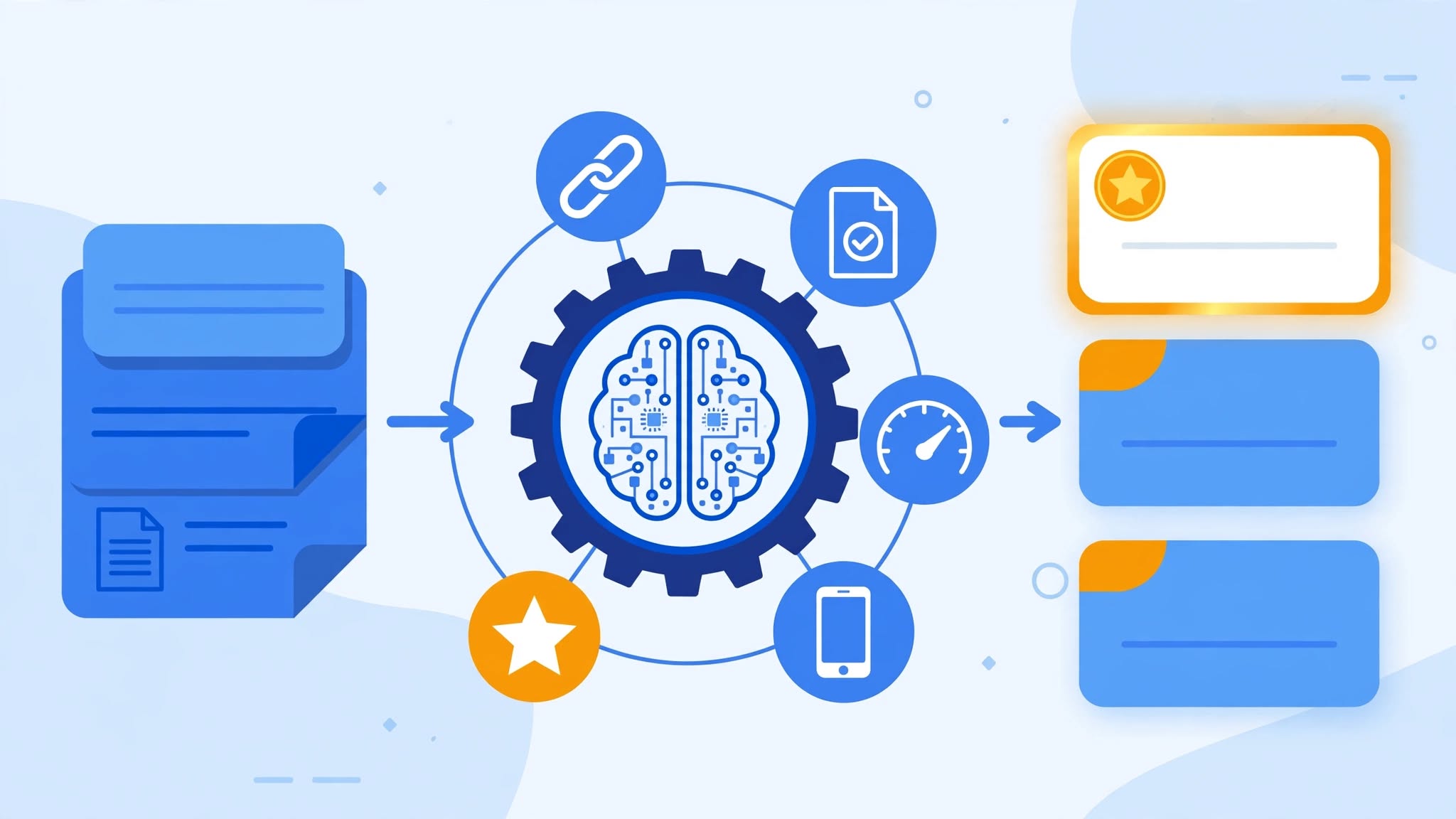
Type a question into Google and somewhere in the background, a decision gets made in a fraction of a second: out of every page that could possibly answer you, which ones actually deserve the top spots?
That decision is made by an algorithm. Or really, as you’re about to see, by a small army of algorithms working together.
A lot of people picture “the Google algorithm” as one single, secret formula sitting in a vault somewhere in California. Feed it a search query, out pops a ranked list. Clean and simple.
It’s nowhere near that simple. And honestly, once you understand why, a lot of confusing SEO advice starts making a lot more sense.
What Is a Search Algorithm, Really?
Strip away the mystery and an algorithm is just a set of steps for solving a problem.
That’s it. A recipe is an algorithm. Step one, preheat the oven. Step two, mix the dry ingredients. Step three, don’t forget the salt (learned that one the hard way once, never again).
A search algorithm does the same basic job, just applied to a much bigger and weirder problem: given a question typed by a human, sort through billions of web pages and figure out which ones genuinely deserve to be shown, in what order.
Here’s the part that trips people up. It’s tempting to think of this as one formula. In reality, it’s closer to a whole kitchen full of cooks, each responsible for one part of the meal, with someone at the end deciding how it all gets plated.
Google itself has said its ranking system looks at hundreds of individual factors. Each of those factors usually has its own smaller process behind it.
Something to judge whether a page’s content matches the topic. Something else to judge whether the links pointing at it look trustworthy or spammy. Another piece evaluating how fast the page loads.
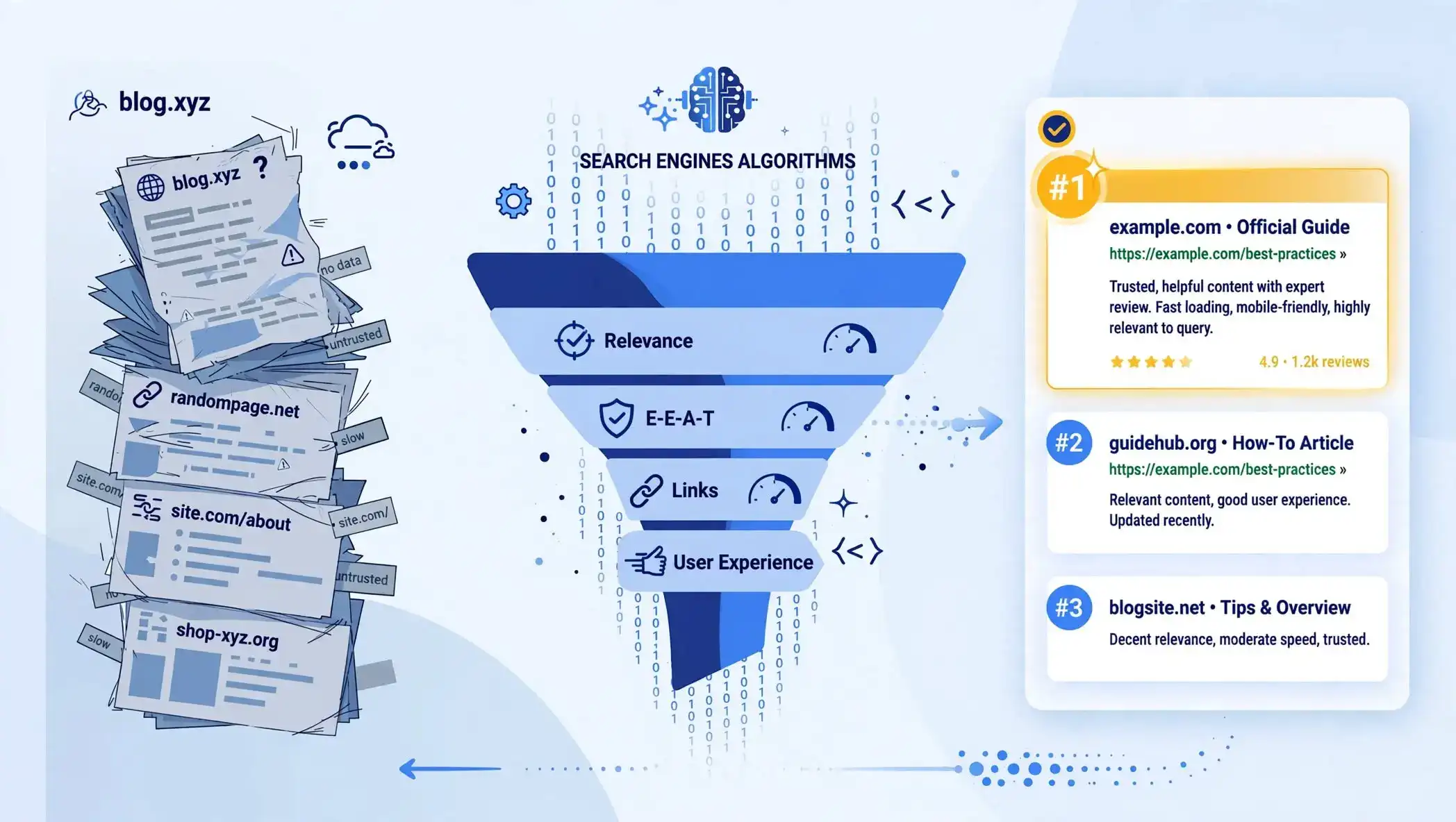
None of these run in isolation, and none of them alone decides anything. They all feed into a larger system that weighs everything and spits out a final order.
So when someone says “the Google algorithm changed,” what actually happened is almost always smaller: one or several of these sub-processes got adjusted, retrained, or replaced, and that shift rippled through the final rankings.
A Quick History: How We Got Here
It helps to understand where this all started, because the evolution explains a lot about why modern algorithms work the way they do.
The directory era
Believe it or not, the earliest way of organizing the web wasn’t search at all, it was directories. Services like the early Yahoo! and a project called DMOZ had actual humans manually sorting websites into categories. It worked fine when there were thousands of sites. It completely fell apart once the web grew into the millions.
The keyword-matching era
Early search engines solved this by counting. Search for “sea turtles” and the engine would simply look for pages containing that exact phrase the most times. This created an obvious and immediate problem: people started stuffing pages with repeated keywords to game the system, regardless of whether the page actually said anything useful.
The link-analysis era
Google’s original breakthrough was treating links between websites as votes of trust. If lots of other sites linked to your page, especially sites that themselves were well-linked-to, your page probably had some real value. This idea, originally formalized in a concept called PageRank, is part of why backlinks became (and largely remain) such a big deal in SEO.
The semantic and machine-learning era
This is where things got genuinely sophisticated. Search engines stopped relying purely on matching exact words and links, and started trying to understand actual meaning, intent, and the relationships between concepts. This is the era we’re still in, and it’s worth slowing down on, because it’s the part most beginner guides gloss over.
Entities: Why Google Thinks in Concepts, Not Just Keywords
Here’s a concept that doesn’t get explained nearly enough, and it genuinely changes how you should think about writing content: entities.
Google defines an entity as a distinct, well-defined thing or concept. A person. A place. A brand. An idea. The actor playing a fictional superhero is one entity. The fictional superhero itself is a separate entity. Your local bakery is an entity. So is the specific type of sourdough it’s known for.
Why does this matter? Because Google increasingly evaluates content not by counting keyword matches, but by mapping out which entities a page is actually about, and how strongly. Two pages might use completely different wording while covering basically the same concept (think “auto repair” versus “car maintenance”), and Google can connect them because it’s tracking the underlying entity, not just the literal words on the page.
This is also why a page that randomly bounces between unrelated topics tends to struggle, even if each section is individually well written. If Google can’t pin down what entity your page is primarily about, it has a harder time deciding which searches it should actually show up for. Sticking to a clear, well-defined topic, and covering it properly, helps the algorithm understand exactly what you’re trying to be relevant for.
RankBrain, BERT, and the Rise of Language Understanding
Google has rolled out several specific systems aimed at understanding language and intent better, and a few names come up constantly in SEO conversations.
RankBrain was one of the earlier moves toward using machine learning directly inside the ranking process. Its main job was handling searches Google had never seen before, which happens far more often than you’d guess, by interpreting the likely meaning behind unfamiliar phrasing rather than relying on exact keyword history.
BERT pushed this further, focusing specifically on understanding the relationships between words in a sentence, including small connector words that completely change meaning. “Can you pick up a parking permit for someone” means something very different depending on tiny shifts in phrasing, and older keyword-based systems struggled with exactly this kind of nuance.
These systems are part of why keyword-stuffing stopped working years ago, and why writing naturally, the way an actual human would explain something to another human, tends to perform better than mechanically repeating a target phrase.
The Named Updates You'll Keep Hearing About
If you spend any time reading SEO discussion boards, certain update names get thrown around constantly like inside jokes. Here’s what they actually targeted.
Notice the general direction here. Nearly every major update over the years has pushed in the same basic direction: reward content that’s genuinely useful and penalize attempts to game the system artificially. That pattern has held up remarkably well over time, even as the specific technology behind it has changed dramatically.
The Major Factors Today's Algorithms Actually Weigh
Google has been unusually open about a handful of broad categories it considers, even while keeping the exact internal weighting private.
What the searcher actually means
Before anything else gets evaluated, the algorithm tries to nail down intent. Is this person trying to learn something, navigate to a specific site, compare options, or buy something right now? Get this categorization wrong and nothing else matters much.
How well a page matches that meaning
Once intent is established, content gets evaluated for actual relevance, not just on the surface level of matching words, but on whether it genuinely covers what someone in that situation would want to know.
Content quality
This is where things like depth, clarity, accuracy, and genuine usefulness come in. A page can be relevant to a topic and still get outranked by a competitor that simply explains things better.
Usability of the page itself
Loading speed, mobile responsiveness, and general ease of navigating the page all factor in. A great answer trapped inside a clunky, slow-loading page is a worse experience than a slightly less polished answer on a page that just works.
Context about you, the searcher
Location, language, device, and even your own past search behavior shape what specifically gets shown to you. Two people typing the exact same query, sitting in different cities, can genuinely see different results.
How Different Search Engines Handle This Differently
It’s worth knowing that not every search engine approaches ranking the same way, even though they’re solving a similar problem.
Google keeps its exact methodology private and relies on an enormous, constantly evolving combination of relevance, quality, and usability signals, layered with personalization.
Bing
Bing is comparatively more open about some of its technical approach, and has historically leaned more heavily on certain signals like social engagement and rich multimedia content than Google has.
DuckDuckGo
DuckDuckGo doesn’t run its own full independent ranking system in the way Google does. A large portion of its results actually come from Bing’s index and a few hundred other sourced providers, blended together, with the notable difference that it doesn’t personalize results based on tracked user data the way the bigger players do.
What this means practically: optimizing well for Google’s general principles (relevance, quality, usability, genuine helpfulness) tends to carry over reasonably well to the others, since they’re all chasing some version of the same underlying goal, even if their specific technical implementations differ.
Where AI Is Changing the Ranking Picture
This is the part that’s genuinely new compared to even a few years ago. AI search engines or AI systems like Google’s AI Overviews, and conversational tools like ChatGPT Search and Perplexity, aren’t just re-ranking the same old list of ten blue links. They’re synthesizing an answer directly, often pulling from multiple sources at once and presenting a blended summary.
This shifts what “ranking well” even means in some contexts. Showing up as a cited source inside an AI-generated answer is becoming a meaningful goal of its own, sometimes separate from your classic position on a traditional results page. Content that states things clearly, directly, and in a well-structured way tends to get pulled into these AI summaries more easily than vague or meandering writing, partly because it’s simply easier for a language model to extract a clean, confident answer from it.
This doesn’t replace traditional ranking. It sits alongside it as an additional layer to think about.
Why You Can't "Solve" the Algorithm, and What to Do Instead
Plenty of people treat SEO like a puzzle with one correct combination waiting to be cracked. That mindset gets people in trouble. There isn’t a magic checklist, because the system is intentionally complex, intentionally private about its internal weighting, and constantly being adjusted specifically to resist gaming.
What actually works, consistently, across nearly every major update in the last fifteen years, is depressingly simple to state and genuinely hard to fake: write content that real people would find useful, present it clearly, make your site technically sound, and build a real reputation over time rather than chasing shortcuts.
Every major algorithm shift, Panda, Penguin, Helpful Content, all of it, has been a correction aimed at sites that tried to skip that fundamental requirement. The sites that keep performing well across update after update tend to be the ones that were never trying to trick the system in the first place.
The Bottom Line
A search algorithm isn’t a single formula you can reverse-engineer. It’s a layered system of many smaller processes, each doing a specific job, feeding into a larger structure that’s been refined for decades and is still actively evolving. Understanding entities, language models, and the historical arc from simple keyword counting to genuine meaning-based understanding won’t hand you a shortcut. But it will help you understand why certain advice exists, why some old tactics stopped working, and why the most boring, repeated piece of SEO advice out there, write something genuinely worth reading, has somehow remained true through every single update along the way.